
Even as the United States prepares to wrap up its final assessment for another round of tariffs in a few months, Cambodia awaits further concessions with bated breath to lock in Most-Favoured-Nation status with zero additional duty — MFN+0. In simple terms, MFN+0 ensures that local goods encounter only standard baseline tariffs, avoiding supplementary Section 301 taxes. This is key for local industries. Additional tariffs would inevitably shoot up export costs and squeeze profit margins. To prevent this, the US-Cambodia Agreement on Reciprocal Trade (ART) establishes that Washington will maintain an additional reciprocal tariff of no more than 19 percent on goods originating from Cambodia, while exempting certain products entirely. Khmer Times consulted experts to gauge the Kingdom’s chances of securing MFN+0. According to one analyst, Cambodia already holds the most favourable position in the region with a flat 10 percent Section 301 add-on—outperforming Vietnam and Thailand’s 12.5 percent; adding that the government should prioritise constructive engagement over confrontation, given its limited leverage to oppose US policy outright. Meanwhile, as Deputy Prime Minister Sun Chanthol negotiates with the US to protect Cambodia’s regional competitiveness, the Kingdom must also carefully balance its relationships with major powers to strengthen its trade resilience
As Washington prepares to conclude a separate investigation that could trigger another tariff on Cambodian exports, the Royal Government is seeking to secure a Most-Favoured-Nation (MFN) tariff with zero additional duty (0%). But what strategic moves can the government make next to protect its trade competitiveness?
The issue has become increasingly important after the United States Trade Representative (USTR) imposed a 10 percent tariff on July 23 under Section 301 following an investigation into whether economies have taken sufficient action to prohibit imports produced with forced labour.
Cambodia was among the few economies to receive the lower 10 percent rate. However, another challenge is approaching, with a separate Section 301 investigation examining structural excess capacity and production in manufacturing sectors.

Launched in March, the investigation covers 16 economies, including Cambodia, China, Indonesia, Malsaysia, Thailand and Vietnam. USTR is examining whether government acts, policies and practices related to excess capacity are unreasonable or discriminatory and burden or restrict US commerce.
The outcome is important for Cambodia because the US is the Kingdom’s largest export market. The country exported over $7 billion worth of goods to the US during the first half of 2026, making the market a critical source of demand for the country’s manufacturing sector.
What would MFN+0% mean?
For Cambodia, MFN+0 percent would mean local goods continue to face the normal US tariff applicable to their product categories, without an additional tariff imposed under Section 301 or other reciprocal tariff measures.
It does not mean completely duty-free access to the US market. Instead, the objective is to remove the additional tariff layer and allow Cambodian exporters to compete under the normal MFN tariff framework.
The distinction is important because an additional tariff can increase export costs, putting pressure on profit margins and competitiveness.
The US-Cambodia Agreement on Reciprocal Trade (ART) established a framework for additional tariff treatment. Under the agreement, the US committed to maintain an additional reciprocal tariff of no more than 19 percent on Cambodian originating goods, while certain products would receive zero percent reciprocal tariff treatment.

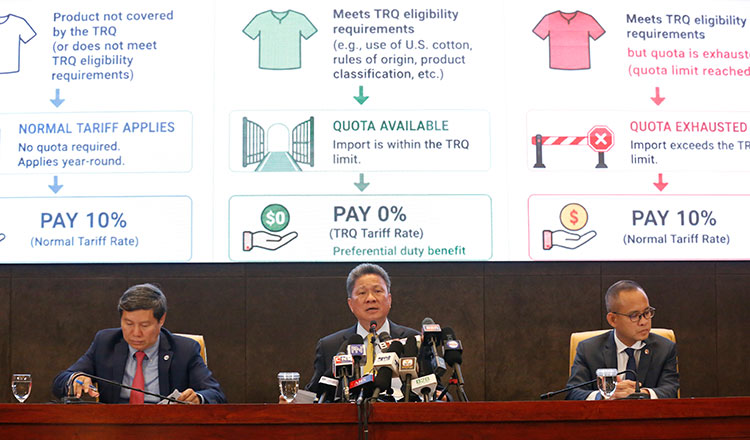
During a press conference in late July, Deputy Prime Minister and First Vice-Chairman of the Council for the Development of Cambodia (CDC) Sun Chanthol said that the Royal Government is working with the US to ensure the Kingdom does not lose its trade competitiveness in the region.
Securing MFN+0 percent would provide exporters with greater certainty over the cost of accessing the US market. This is particularly important for garments, footwear, travel goods and other manufacturing products that compete with suppliers across the region.
Even a relatively small difference in tariff treatment can influence where international buyers place orders and where manufacturers establish production. A lower and more predictable tariff burden could therefore help Cambodia retain existing orders and attract companies seeking to diversify their supply chains.
The immediate risk is the pending excess-capacity investigation. USTR has not announced a final determination or remedy, but another tariff could increase costs for Cambodian exporters and weaken their competitiveness.
The impact would depend on the level and scope of any new measure and how it interacts with existing tariff arrangements. Exporters could absorb higher costs, accept lower margins, raise prices or reconsider production decisions.
There is also an investment risk. If Cambodia faces a higher tariff burden than competing manufacturing destinations, international companies could reassess planned investments or shift production elsewhere.

Cambodia’s expanding manufacturing base could also face greater scrutiny if Washington concludes that the Kingdom’s production growth contributes to structural excess capacity. The Royal Government will need to demonstrate that manufacturing growth is driven by market demand and foreign investment rather than state-supported overproduction.
Trade deficit barriers
Securing MFN+0 will not be straightforward. The US has a large goods trade deficit with Cambodia, while Washington’s trade policy places greater emphasis on reducing trade imbalances, expanding US exports and strengthening domestic manufacturing.
Cambodia’s negotiating position will therefore depend not only on the importance of the US market but also on what it can offer in return. Greater purchases of US goods and raw materials, stronger supply-chain cooperation, improved enforcement against trade and customs violations, and continued compliance with US requirements could become important elements of the discussions.
The challenge is to convince Washington that favourable tariff treatment for Cambodia can also support US economic interests rather than simply benefit Cambodian exporters.
For Cambodia, the goal is therefore broader than securing a lower tariff in the short term. It is about establishing a more predictable trade environment in which Cambodian exports face the normal MFN tariff applicable to each product without another additional tariff layer.
The coming months could be critical as USTR moves towards a decision on the excess-capacity investigation. Whether Cambodia can secure MFN+0 will depend on its ability to address Washington’s concerns while demonstrating why continued access to the US market serves both sides.

Responding to Khmer Times’ query on whether Cambodia can realistically secure an MFN+0 tariff arrangement, Dean of the Faculty of Social Sciences and International Relations of Paññāsāstra University of Cambodia (PUC) Kevin Nauen said, “Realistically, not economy-wide.”
He explained that Cambodia already holds the best available tier, with a flat 10 percent Section 301 add-on, compared with Vietnam and Thailand’s 12.5 percent, following the International Emergency Economic Powers Act (IEEPA) and its replacement with Section 301.
“The closest thing to MFN+0 percent is the pending textile tariff-rate quota (TRQ) for garments made with US cotton or fabric. Cambodia is one of only four countries eligible, but it is unimplemented, and the USTR’s own framework keeps an add-on layer for nearly everyone,” Nauen said.
Asked what Cambodia should do to convince Washington that its manufacturing sector is driven by market demand and foreign investment rather than state-supported excess capacity, Nauen said Cambodia should focus on the excess-capacity investigation.
He explained that Cambodia should highlight three distinctions: labour-intensive garment and footwear assembly differs from capital-intensive, subsidised sectors such as steel, solar and electric vehicles; manufacturing growth is driven by Western brand demand rather than idle subsidised capacity; and enforcement of rules of origin, the duty-evasion cooperation pact and US-input sourcing demonstrate active anti-transhipment policing.
“This constructive-engagement posture over confrontation should be taken, given Cambodia has limited room to oppose outright,” the PUC Dean noted.

Asked whether the Agreement on Reciprocal Trade (ART) gives Cambodia additional leverage, he said, “Modestly, and indirectly.” He noted that the agreement’s 19 percent US tariff ceiling lost its relevance after the Supreme Court struck down the IEEPA.
“But the agreement’s forced-labour, transhipment and state-owned enterprises (SOEs) commitments are precisely what earned Cambodia the lower 10 percent, versus 12.5 percent, tier and TRQ eligibility under the new Section 301 framework,” he added.
On Cambodia’s regional competitiveness, Nauen said the tariff advantage was “meaningfully positive right now, but not decisive”. Cambodia’s 10 percent tariff edge over Vietnam and Thailand’s 12.5 percent coincides with strong 2026 export growth, with exports reaching around $7.5 billion in the first half of the year, up more than 30 percent year on year.
He stressed that Council for the Development of Cambodia (CDC) leadership has warned against complacency, citing Chinese-input dependence, factory scale, and looming European Union Everything But Arms (EBA) and least developed country (LDC) graduation risks that a narrow tariff advantage may not offset while the excess-capacity ruling remains unresolved.
“Tariffs are a tailwind factor going forward but not the structural differentiator,” the PUC Dean added.
Speaking to Khmer Times, President of the Logistics Supply Chain and Brokers Business Association in Cambodia (LOSCBA) Chea Chandara said the current 10 percent tariff has not significantly affected Cambodian exporters, noting that many countries in the region face tariffs of up to 15 percent.
“Additionally, low labour costs allow investors to generate good returns,” he said. However, he stressed that the US market remains particularly important, as about half of the Kingdom’s exports are destined for the US.
“Cambodia exports to many markets around the world, but about half of our goods go to the US, so this market is very important. If we fail to secure favourable tariff treatment, it would be a major concern,” he said.
US market reliance
Chandara added that Cambodia’s trade with neighbouring countries remains limited and cannot replace the US market. “Trade with neighbouring countries is still limited and at an early stage. We have seen some trade between Cambodia and China through the Laos route, but it is still at the starting point.”
“Trade with Vietnam has stronger potential, as Vietnam buys significant amounts of raw agricultural materials from Cambodia for processing and re-export,” he said.
The LOSCBA President emphasised that securing favourable US tariff treatment is essential to maintaining Cambodia’s competitiveness. “From the exporters’ perspective, we would actually like the tariff to be below the current 10 percent. If the US imposes an additional tariff, it would be a major concern,” he said.
He noted that a higher tariff could also affect Chinese investment, depending on its type and target market. “If the investment targets local or regional markets, the impact would be limited. But if it targets exports to the US market, then it would be affected,” he said.
Chandara urged the Royal Government to continue complying with US requirements, particularly by increasing the use of US raw materials. “The US wants Cambodia to import its raw materials, process them and export the finished products back to the US with duty-free treatment,” he said.
He also called for Cambodia to strengthen its capacity to transform raw materials into higher-value products. “Simply importing raw materials from other countries and assembling them in Cambodia will not strengthen our economic resilience. We need to increase our capacity to process raw materials and create more value domestically,” he said.
The LOSCBA President further stressed the importance of balancing Cambodia’s economic relations with major powers to maximise economic opportunities and strengthen trade resilience.
Crucial economic survival
Vice President of the Federation of Associations for Small and Medium Enterprises of Cambodia (FASMEC) Dr Sam Soknoeun told Khmer Times that securing an MFN+0 is important for Cambodia’s competitiveness, as the US is a strategic destination for Cambodian exports and a major contributor to economic growth.
“Securing MFN+0 would also attract more foreign direct investment (FDI) into industries and production facilities in the Kingdom. It would encourage more purchase orders from the US for garments, footwear and travel goods, further increasing their share of Cambodia’s overall trade,” he said.
Dr Soknoeun, also Chairman of SAM SN Group, noted that Cambodia’s exports to the US exceeded $7 billion in the first half of 2026, up nearly 30 percent from the previous year.
He noted that MFN+0 would apply to 154 types of Cambodian goods, which could also encourage Chinese companies struggling to export to the US to invest in Cambodia.
Turning to Cambodia’s negotiating position, Dr Soknoeun said that the Kingdom’s decision to reduce import duties to zero percent on a range of US products is one of its strongest points in discussions with Washington.
He added that the US has also pledged to maintain the competitiveness of Cambodian exports by keeping Cambodia’s tariff below those faced by neighbouring countries such as Thailand and Vietnam, which he viewed as an indication of the US market’s openness to Cambodia.
“The US does not focus on producing garments, footwear and travel goods and needs to import these products from Cambodia. Cambodia also has a competitive labour force, which provides an important basis for the Royal Government’s negotiations,” he said.
On forced labour and excess capacity concerns, Dr Soknoeun noted that the Royal Government has established an inter-ministerial working group to address the issues and ensure compliance with US rules and regulations.
“The fact that the US imposed a 10 percent tariff on Cambodian goods under Section 301, compared with 12 to 15 percent on other countries, shows that Cambodia has made significant efforts,” he said.
Beyond government-to-government negotiations, Dr Soknoeun said that Cambodian businesses also have a role to play by selecting proper and transparent supply chains and avoiding illegal suppliers.
“If businesses work with illegal suppliers simply to obtain cheaper goods, it could lead to additional tariffs being imposed on Cambodia, which would eventually affect their businesses,” he said.
He also encouraged Cambodian businesses to consider sourcing raw materials such as cotton and fabric from the US, processing them in Cambodia and re-exporting the finished products to the US to benefit from duty-free treatment.
The SAM SN Group Chairman urged the Royal Government to further strengthen Cambodia’s competitiveness and diversify export markets, while focusing on reducing logistics and production costs and improving product quality.