

PHNOM PENH — Techo International Airport has given Cambodia the aviation infrastructure it long needed.
What the country lacks now is the passenger demand to fill it. The $2.3 billion airport can handle up to 15 million passengers a year, but traffic has fallen sharply in 2026, raising questions about how quickly Cambodia can turn its expanded capacity into a stronger aviation and tourism network.
The airport, which opened last year, is the centerpiece of Cambodia’s rapid aviation expansion. Along with the new Siem Reap Angkor International Airport, which opened in 2023, it has significantly increased the country’s capacity to handle international travelers.
But Cambodia’s challenge has shifted from building airport infrastructure to making sure airlines can fill it.
Passenger demand has weakened, several routes have struggled or been suspended, and limited domestic connections make it difficult for travelers arriving in Phnom Penh to reach other major tourism destinations. Experts say Cambodia needs a more coordinated approach to route development, tourism promotion and airline support if it wants to turn its new airport capacity into sustainable growth.
Sin Chansereyvutha, spokesperson for the State Secretariat of Civil Aviation (SSCA), said Cambodia’s aviation sector is going through a period of adjustment and recovery in 2026, bringing both opportunities and challenges.
During the first seven months of the year, Cambodia received around 3.71 million air passengers, a 9 percent decline from the same period in 2025. Flights fell by about 1 percent to 37,248, while air cargo rose 21 percent to around 57,103 tonnes.
“We should not look only at passenger numbers as a single indicator, but also consider passenger traffic, the number of flights, air cargo, international connectivity, airport capacity, and the broader economic and tourism situation,” Chansereyvutha said.
Although passenger demand has slowed temporarily, he said cargo and logistics-related economic activity have shown positive signs.
Facing a Demand Problem
Dutch tourism expert Peter Brongers said Cambodia has largely closed the gap in airport infrastructure but now faces a different problem: there are not enough passengers to fill the new capacity.
Techo International Airport opened last year with the capacity to handle 13 million to 15 million passengers annually. It followed the opening of Siem Reap Angkor International Airport in 2023.
But passenger traffic has not kept pace.
Techo International Airport handled about 656,000 arrivals in the first five months of 2026, down almost 26 percent from a year earlier. Siem Reap recorded about 274,000 arrivals, a decline of 11 percent.
Sihanoukville, the main gateway to Cambodia’s southern coast, currently receives just five flights a week, compared with more than 700 at Techo International Airport.
Brongers said Cambodia’s route network tells a similar story.
There have been clear gains. Etihad and Turkish Airlines both launched services to Phnom Penh over the past year, strengthening Cambodia’s links with major international markets.
But several other routes have struggled.
Firefly launched a Kuala Lumpur-Siem Reap service in November 2025 but withdrew just three months later. IndiGo dropped its Siem Reap-Kolkata route in July, even as Cambodia was actively targeting the Indian market through a dedicated tourism year.
Lao Airlines has also suspended its Siem Reap service, while Thai AirAsia cut its Bangkok-Phnom Penh flights in half, from 14 to seven per week.
According to the SSCA, Cambodia has a relatively broad international aviation network, with around 33 airlines connecting the country to markets across ASEAN, East Asia, South Asia and the Middle East. During the first half of 2026, 29 international airlines, including four domestic airlines, were operating in Cambodia.
But the size of the network has not translated into passenger numbers comparable with those of neighboring countries.
Vietnam handled 45 million passengers in the first half of 2026 alone and overtook Thailand in August to become Southeast Asia’s second-largest market by scheduled seats, Brongers said.
Cambodia also faces growing competition from other regional destinations.
On Vietnam’s Phu Quoc island, a second runway and new terminal are being developed, with Changi Airports International providing advisory support. The expansion is intended to raise annual capacity to 20 million passengers ahead of Asia-Pacific Economic Cooperation 2027.
Phu Quoc itself handled around six million passengers last year. By comparison, Cambodia’s three international airports combined processed just 2.4 million passengers in the first four months of 2026.
Local Airlines Make Progress, But Scale Remains a Problem
Cambodian airlines have made progress, but they remain at a disadvantage compared with larger regional carriers.
Chansereyvutha said local airlines face a significant scale gap. Major regional carriers operate larger fleets, extensive hub-and-spoke networks and have greater financial resources.
That makes competing mainly on ticket prices a risky strategy.
Cambodian airlines should instead build on areas where they can develop a stronger advantage, he said, including better domestic connectivity and stronger links between Phnom Penh and destinations such as Siem Reap, Sihanoukville and Koh Kong.
Brongers also emphasized the need to improve connections beyond Phnom Penh and Siem Reap.
Visitors arriving at Techo International Airport, for example, have no straightforward way to reach Cambodia’s southern coast on the same day, he said.
Without domestic flights or transfers coordinated with international arrivals, destinations such as Sihanoukville, the islands, Kampot and Kep depend on travelers willing to spend three or four hours traveling by car.
“Building a large airport does not automatically mean bringing passengers,” Brongers said. Cambodia also needs to support new routes if it wants to attract more tourists.
One option is financial support for new routes.
“No airline commits an aircraft to an unproven route out of goodwill. Thailand’s tourism authority helps reduce the financial risk by guaranteeing blocks of seats or co-funding an opening year. The Cambodia Tourism Board could do the same, given a budget to do it with,” he said.
Brongers also said Cambodia should promote new routes aggressively in their source markets as soon as they are announced.
Etihad and Turkish Airlines now fly into Techo International Airport, for example. But those routes will have limited value if potential travelers in Abu Dhabi or Istanbul have little reason to choose Cambodia.
Air Cambodia Plans Regional Expansion
Despite intense competition and a shortage of skilled aviation professionals, national flag carrier Air Cambodia plans to expand its fleet, routes and international partnerships to strengthen the country’s regional connectivity.
Vice CEO Lim Kao said the airline faces many of the same challenges as other fast-growing carriers.
“The regional market is highly competitive, with a strong presence from both low-cost carriers and established foreign airlines. Rising operational costs, fuel price volatility, and global geopolitical uncertainties also put pressure on the airline’s planning and margins,” Kao said.
The rapid expansion of Cambodia’s aviation sector has also exposed a shortage of technical professionals.
“As we scale up our fleet and network, we face a growing shortage of technical personnel, particularly pilots, engineers, and maintenance staff. This is a structural challenge that affects not only our airline but the broader Cambodian aviation industry,” he said.
Air Cambodia is responding by diversifying its fleet among manufacturers from Europe, the United States and China. It also plans to train 200 Cambodian-licensed aircraft engineers over the next five years.
Following its rebranding from Cambodia Angkor Air in January 2025, the airline has focused on modernization and international expansion.
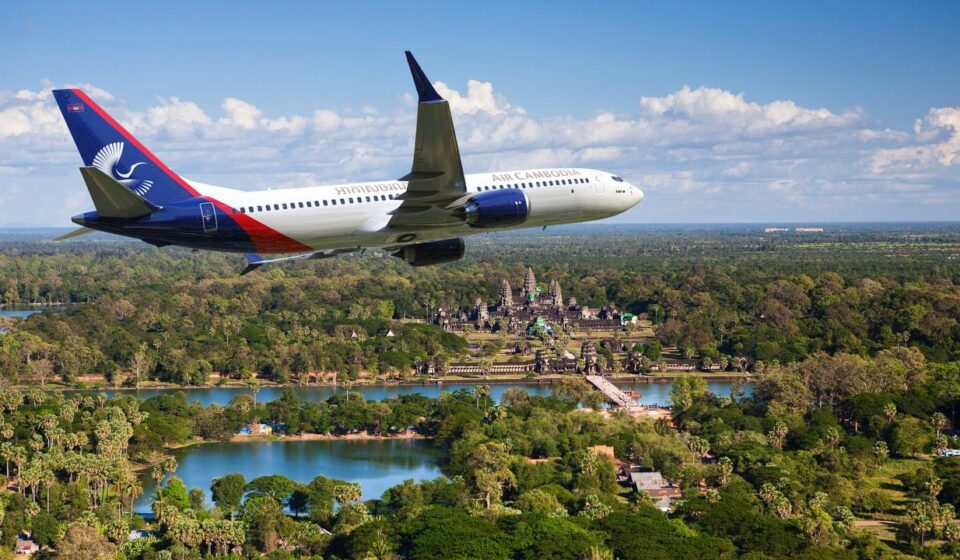
Air Cambodia now operates Airbus A320 family aircraft and ATR 72-600s, with dual hubs at Techo International Airport and Siem Reap Angkor International Airport.
“Our network covers domestic destinations, major cities in China, and several Southeast Asian countries. We are proud to be the only Cambodian airline with IATA Operational Safety Audit (IOSA) certification and a Skytrax 3-star rating,” Kao said.
The airline aims to become a leading regional carrier over the next decade through fleet modernization and network expansion.
It has added newer, more fuel-efficient aircraft, including three ATR 72-600s delivered in 2025.
Air Cambodia has also signed a purchase agreement with COMAC for 20 C909 aircraft, consisting of 10 firm orders and 10 options. It has a further 20 Boeing 737 MAX 8 aircraft on firm order.
“Our medium-term goal is to grow our fleet to around 33 aircraft by the early 2030s, and we are evaluating wide-body aircraft for future long-haul services,” Kao said.
The airline is also looking to expand into high-potential markets across Northeast Asia, South Asia and beyond, while exploring long-haul intercontinental services as part of its longer-term strategy.
So far, Air Cambodia has codeshare and interline agreements with 28 major airlines worldwide. The partnerships are intended to expand connections between Cambodia and destinations across the Middle East, Europe, Africa and beyond.
Cambodia Needs More Than New Flights
For Chansereyvutha, improving Cambodia’s aviation sector will require more than adding flights or protecting struggling airlines.
He outlined eight measures aimed at helping Cambodian carriers compete more effectively while avoiding permanent support for inefficient operators.
The first is a National Route Development Strategy that identifies priority markets, including ASEAN, China, South Korea, Japan, India and other high-potential tourism and business destinations.
The strategy should use data on passenger demand, tourism and trade flows to determine which routes should be developed and promoted.
Second, Cambodia should consider temporary route-development incentives for new services or promising markets that have not yet become commercially viable.
These could include airport incentives, joint marketing, tourism promotion or other promotional support for a limited period. Chansereyvutha stressed that such measures should be transparent and applied fairly to avoid distorting competition.
Closer coordination between the tourism and aviation sectors will also be essential.
Opening a new route requires cooperation among the SSCA, Ministry of Tourism, airports, airlines, tour operators and private-sector partners to promote Cambodia as a destination, he said.
Cambodia should also strengthen commercial partnerships rather than relying entirely on airlines to launch and operate routes themselves.
Codeshare and interline agreements, Special Prorate Agreements (SPAs) and participation in international airline networks can give Cambodian carriers access to a wider range of destinations without requiring direct flights to every market.
Fleet modernization is another priority. Cambodia needs to improve airlines’ access to financing for aircraft purchases and leases, while choosing aircraft that are appropriately sized for routes where passenger demand remains limited.
The sector must also reduce structural costs and improve efficiency. That includes reviewing expenses related to airports, fuel, ground handling, air navigation services and regulatory procedures without compromising safety or service quality.
Human capital is equally important.
Cambodia needs to invest in pilots, aircraft engineers, maintenance workers, aviation safety specialists and commercial aviation professionals, as well as digital and artificial intelligence capabilities.
“We cannot build competitive and sustainable airlines in the long term by relying solely on aircraft. Aircraft can be purchased or leased, but aviation capability has to be built,” Chansereyvutha said.
Finally, Cambodia should continue pursuing a liberal and pragmatic air-service policy, making use of bilateral traffic rights, the ASEAN Open Skies framework, Fifth-Freedom Rights and other available arrangements where appropriate.
But those policies should be guided by the national interest, market potential and long-term competitiveness, Chansereyvutha said.
For Cambodia, the challenge is no longer simply building airports or adding international flights. The harder task is turning Techo International Airport’s new capacity into a sustainable aviation network that brings in passengers, connects them efficiently to destinations across the country and gives Cambodian airlines a realistic path to compete in the region