
PHNOM PENH – Declining development finance across Southeast Asia is putting additional pressure on poorer countries such as Cambodia, which have fewer alternatives to foreign aid for funding infrastructure and essential social services.
With traditional donors cutting back amid competing domestic and geopolitical priorities, the funding shortfall is expected to deepen, marking a potentially lasting shift in the region’s development financing landscape.
Experts say how Cambodia manages that shift will matter as much as the size of the shortfall, from negotiating better terms on borrowing to bringing in private capital and protecting essential services.
The Australia-based Lowy Institute’s 2026 Southeast Asia Aid Map indicates that total official development finance (ODF) to Southeast Asian countries fell by 9.8 percent to $26.1 billion in 2024, the latest year for which comprehensive data is available, from $28.9 billion in 2023.

Funding from traditional bilateral partners is expected to fall further, while China is also reducing its aid rather than filling the gap.
Meanwhile, multilateral development banks (MDBs), including the Asian Development Bank (ADB), the World Bank and the Asian Infrastructure Investment Bank (AIIB), have overtaken bilateral partners as a source of development finance.
China remains the region’s largest infrastructure partner but new project signings have stalled. The report noted that several traditional bilateral development partners have publicly announced official development assistance (ODA) cuts for 2025–27. These include Austria, Belgium, Finland, France, Germany, the Netherlands, New Zealand, Sweden, Switzerland, the United Kingdom and the United States.
Rahul Nath, the report’s lead author, said development finance to the region reached a decade low in 2024, with funding expected to fall further in 2025.
Driven by the retreat of bilateral donors, the decline has long-term implications for Southeast Asia’s economic growth, particularly its ability to build resilience as the region grapples with external shocks.
“Cascading shocks of the last decade have placed increased pressure as countries have had to continuously re-prioritise budgets to critical short-term crisis support,” Nath said.
Such a trend placed considerable strain on efforts to build resilience, particularly as funding is diverted from longer-term human capital development projects, including health care and social protection, which are critical to sustainable economic growth.
“ODF can take some of the pressure off already stretched domestic budgets and help countries to safeguard their resilience,” he said.

ODF to Cambodia Also Declines
According to the report, 19,719 aid and development projects were implemented in Cambodia between 2015 and 2024 by 80 development partners, totaling $25.47 billion in ODF.
China, Japan and financial institutions such as the ADB and the World Bank have been Cambodia’s primary development partners, together accounting for 58.5 percent of the country’s ODF since 2015. In 2024, China accounted for 30 percent of total ODF to Cambodia, down from 47 percent in 2021.
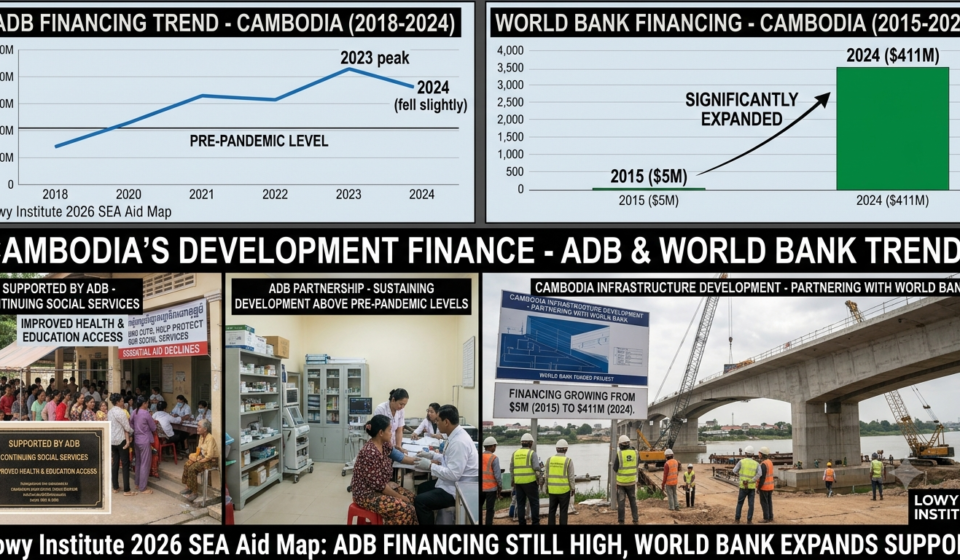
Japan has remained a steady development partner, although its ODF support to Cambodia fell by 37 percent in 2024. Meanwhile, the ADB increased its support to Cambodia between 2015 and 2024, with funding peaking in 2020 due to substantial budget support during the COVID-19 pandemic.
Although ADB financing fell slightly in 2024 compared with 2023, it remained above pre-pandemic levels. The World Bank has also significantly expanded its financial support to Cambodia, increasing its spending from $5 million in 2015 to $411 million in 2024.
Transport and storage, including road construction, has received the largest share of development finance in Cambodia. Since 2015, the sector has accounted for 30 percent of all ODF to the country, well above the regional average of 18 percent.
Meanwhile, energy generation and access have received a smaller share of funding, accounting for less than 10 percent of Cambodia’s ODF, compared with the regional average of 17 percent.
Nath noted that Cambodia had diversified its financing base since 2015 as the volume of ODF increased.
In 2024, Cambodia received 66 percent of its ODF through concessional loans, which carry relatively low interest rates and can help support sustainable borrowing. Between 2015 and 2024, such loans accounted for 49 percent of the country’s total ODF.
Reliance on non-concessional debt, including loans offered at market rates or on less favorable terms, has declined. Such loans accounted for 13 percent of Cambodia’s ODF in 2024, compared with 21 percent over the 2015–2024 period.
Sophal Ear, an associate professor at the Thunderbird School of Global Management at Arizona State University and author of Aid
Dependence in Cambodia, warned that the impact of declining development finance would be felt both immediately and over the long term, though the effects would vary across countries.
More concerning, he said, was that the decline is unlikely to be temporary or merely the result of short-term budget adjustments by development partners, particularly members of the Organisation for Economic Co-operation and Development (OECD).
“It suggests a structural change in the international development environment as traditional donors face competing domestic, security and geopolitical priorities,” Sophal said.

While more developed economies can rely on domestic capital markets, private investment and government revenue to finance much of their development, poorer countries, including Cambodia, Laos and Timor-Leste, have fewer alternatives. This is particularly true for investments that generate substantial social benefits but offer little immediate commercial return.
“Roads, rural health care, education, sanitation and climate adaptation are especially vulnerable,” he said.
A Difficult Transition Ahead of LDC Graduation
For Cambodia, Sophal said the timing was particularly difficult as the country remains classified as a least developed country (LDC), with graduation scheduled for December 2029.
Although graduation recognizes genuine development progress, it does not mean that poverty, institutional weaknesses or development financing needs have disappeared, he said.
“This is an uncomfortable transition, increasingly expected to finance its own development before its domestic revenue base and public institutions are fully capable of doing so,” Sophal said.
The main danger is not necessarily an immediate collapse in economic growth, but a gradual deterioration in the foundations of future growth, particularly human capital, public health and infrastructure maintenance.
“Development finance is most consequential precisely where private investors have the least incentive to invest,” he said.
How Cambodia Can Cope
Declining ODF from traditional development partners is putting additional pressure on Cambodia, raising questions about how the country can secure alternative funding to continue modernizing its critical infrastructure.
Sophal said Cambodia needed to ensure that it could manage the shift in its financing base effectively.
“Cambodia needs to ensure there is sufficient donor competition for projects that will be debt-financed to ensure the best terms,” he said.
At the same time, Cambodia must carefully monitor debt-financed projects and maintain diversity among bilateral lenders to avoid “trading one dependency for another,” he added.
Asked how Cambodia could minimize funding shortfalls for critical infrastructure, Sophal said the country needed to make greater use of financing structures that bring in private-sector capital alongside development partner ODF.
“This approach is increasingly important not just for Cambodia, but all Southeast Asian countries as aid cuts continue,” he said.
“Policy reforms that strengthen the enabling environment in Cambodia will be important for getting both domestic and international private capital.”
Sophal also acknowledged that development finance was becoming less predictable and more competitive, requiring Cambodia to strengthen domestic revenue mobilization while improving public investment decisions.
“It also needs to diversify financing and protect essential social services,” he said.
Nevertheless, international development partners also share responsibility for managing the transition. Sophal said Cambodia’s graduation from LDC status should be treated as a managed transition rather than a justification for withdrawing assistance before the country can sustain its development gains.
“The central challenge is to ensure that Cambodia’s growing economic independence translates into stronger institutions and better services for its population,” he said, adding that the goal should be to achieve greater independence “rather than simply replacing dependence on foreign aid with dependence on foreign debt.”
Although declining development finance threatens vital sectors in Cambodia, Sophal said a realistic transition could not involve donors simply withdrawing and expecting the government to replace their funding overnight.
“That would risk reversing development gains, especially in health care, education, nutrition, social protection and services for vulnerable populations,” he said.
“The transition needs to be negotiated, gradual and sector-specific, with a clear understanding of which services are donor-dependent, how much they cost and what would happen if external financing disappeared.”
Sophal said a comprehensive assessment of donor-financed programs should be conducted to distinguish essential recurring services from temporary projects. Cambodia would then need a multiyear plan to incorporate the most important recurring expenditures into the national budget.
“The government will also have to make difficult choices as it cannot necessarily preserve every donor-supported project in its existing form,” he said.
Ultimately, the transition should be from donor-financed services to domestically financed public institutions, rather than simply shifting from one external donor to another.
He warned that Cambodia risked turning a development financing problem into a debt problem if it replaced Western grants with foreign loans to pay for recurring social services.

A woman buys bread along a street in Phnom Penh on June 26, 2026. (Photo by TANG CHHIN Sothy / AFP)
Can Domestic Revenue Fill the Gap?
Sophal said that while raising domestic revenue was necessary, it would be unrealistic to expect Cambodia to offset a substantial reduction in development assistance quickly through higher taxes.
“Cambodia has made considerable progress in revenue administration over the past two decades, but the tax base remains relatively narrow, informality is widespread, and many households and small businesses have limited capacity to absorb additional taxation,” he said, citing International Labour Organization estimates that 88 percent of Cambodian workers are employed in the informal sector.
Rather than simply increasing tax rates, Cambodia should improve the effectiveness and fairness of revenue collection, he said. Priorities include strengthening tax compliance among larger businesses, improving customs administration, reducing unnecessary exemptions, expanding digital tax administration and addressing revenue leakages.
“Bringing more businesses into the formal economy is important, but formalization must offer benefits, including easier registration, access to finance, predictable regulation and social protection,” he said. “Otherwise, businesses may view it simply as another cost and remain informal.”
Tax reform also requires decisions about who pays, who receives exemptions and whether politically connected economic actors are subject to the same rules as everyone else.
“If the burden falls disproportionately on compliant businesses and ordinary households while powerful interests retain preferential treatment, revenue mobilization can undermine confidence in government,” he warned.
The priority, Sophal said, should be to ensure that domestic revenue grows alongside the economy rather than simply extracting more from an already constrained economic base.
“Greater productivity, higher-value employment and a larger formal sector will ultimately do more to strengthen Cambodia’s fiscal position than aggressive short-term tax collection,” he said.