
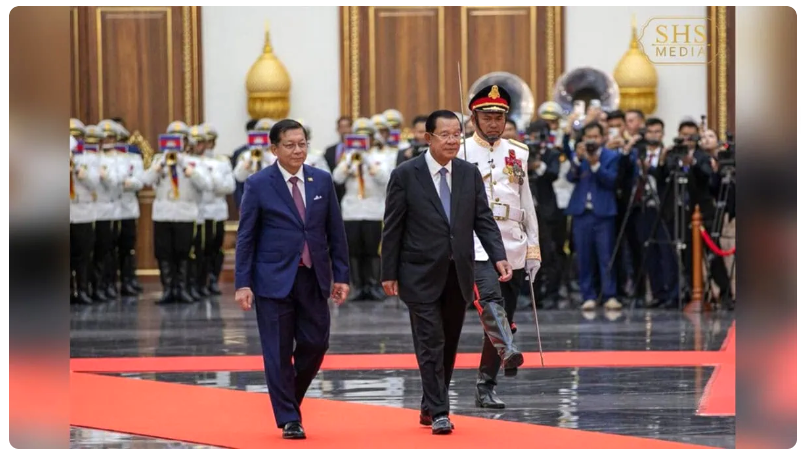

Cambodia’s position in relation to Myanmar has come under heightened scrutiny at a time when Southeast Asia is facing challenges involving conflict, sovereignty, and international law. Cambodia’s longstanding emphasis on its identity as a peace-loving nation and its decision to host high-level state visits by Myanmar’s leadership raise questions about how this engagement relates to Cambodia’s international legal commitments. The question is not just why Cambodia decided to engage with Myanmar, but also what this interaction may reveal about Cambodia’s approach to peace and diplomacy.
According to a statement by Cambodia’s Ministry of Foreign Affairs and International Cooperation, Cambodia’s position during the recent Cambodia-Thailand border tension emphasises respect for international law and the peaceful settlement of disputes.
There are serious concerns about whether Cambodia’s engagement with Myanmar is consistent with this stance. But the apparent tension becomes easier to understand when peace is viewed not only as a moral principle, but also as a diplomatic practice involving dialogue, negotiation, the rule of law and the maintenance of avenues for resolving disagreements.
Cambodia’s diplomatic approach emphasises that peace has always meant more than just the absence of conflicts. The diplomatic preference is particularly understandable for a country whose recent history shows the profound human and political costs of prolonged conflict. This emphasis was also expressed by Prime Minister Hun Manet. On April 26, he described peace as a “tremendous achievement.
On May 15, he emphasised this stance, noting that “even if there were only a one-per-cent chance of resolving a dispute peacefully, Cambodia would continue pursuing dialogue and legal mechanisms to the end in order to safeguard peace for the nation and its people”.
In this sense, Cambodia’s engagement with Myanmar can be seen as an effort to maintain and strengthen diplomatic relations, rather than an endorsement of the conduct by the Myanmar authorities.
Myanmar’s leadership visits also raise the question: Does engagement with Min Aung Hlaing undermine Cambodia’s commitment to the Rome Statute?
According to the International Criminal Court (ICC), the Prosecutor of the ICC filed an application for an arrest warrant against Min Aung Hlaing in November 2024, concerning alleged crimes against humanity targeting the Rohingya population.
In light of the Prosecutor’s application, Cambodia’s status as a state party to the Rome Statute naturally raises questions about how its bilateral diplomacy aligns with its international legal commitments. However, the Prosecutor’s application is different from an arrest warrant issued by the Court.
The main difference is that an ICC Prosecutor’s application is a formal request for a warrant, while an arrest warrant is the official legal order, which is issued by judges after they review and approve that request.
It is understandable that the case has intensified scrutiny of Cambodia’s decision to host a Myanmar leadership state visit. This high-level diplomatic hospitality carries significant meaning, especially when the visiting leadership is under international scrutiny.
However, diplomatic engagement should be differentiated from political endorsement and should not be taken as evidence that Cambodia is disregarding its international legal commitments. Cambodia’s diplomatic engagement with Myanmar and the ICC’s judicial process operate in different domains. This means that maintaining a relationship with a government does not determine the outcome of an independent judicial process, nor should diplomatic engagement be interpreted as political endorsement of the conduct under scrutiny.
Therefore, Cambodia can pursue bilateral engagement while continuing to uphold its obligations under the Rome Statute. What matters most is how Cambodia can balance its diplomatic interests with its commitment to international law and accountability.
Comparing Cambodia’s Diplomatic Approaches to Thailand and Myanmar
Beyond the legal questions, Cambodia’s engagement with Myanmar also raises a broader question about the consistency of its diplomatic approach. A comparison of its approaches toward Thailand and Myanmar would seek clarification on how Cambodia balances different diplomatic principles in different circumstances.
Cambodia’s position toward Thailand has emphasised peaceful settlement of disputes in accordance with international law and dialogue. Meanwhile, its approach to Myanmar has focused on dialogue, respect for sovereignty, non-interference and continued ASEAN engagement. The approaches reflect that peaceful diplomacy does not always rely on a single instrument or identical language for every crisis.
Different circumstances require different diplomatic approaches. Cambodia’s positions in both cases reflect a broader preference for diplomacy over escalation. Whether through international legal mechanisms, bilateral dialogue or regional engagement, Cambodia has sought to keep disputes and crises within peaceful means rather than allowing them to descend into confrontation.
This interpretation is also consistent with remarks made by Senate spokesperson Chea Thyrith during a September 11 press conference, in which he emphasised that Myanmar’s state visit demonstrated efforts to strengthen friendly relations between the two nations, while Cambodia’s position was grounded in respect for the ASEAN principle of non-interference.
The more difficult issue concerns perception and credibility. Will Cambodia’s engagement with Myanmar be viewed as consistent with the values of international law and peaceful settlement of disputes, which it constantly emphasises in its dealings with Thailand?
This depends on whether peace is seen as requiring isolation from challenging actors or, conversely, as requiring a willingness to maintain diplomatic channels even during the most challenging times in relations.
Small-State Diplomacy: National Interests and Trade-offs
From small states’ perspective, diplomatic value often comes from its ability to maintain relationships across political divides rather than from coercive power. Cambodia does not rely on military or economic means comparable to major powers to shape regional outcomes. This means Cambodia’s continued access to Myanmar’s leadership allows the country to remain an active participant in regional dialogue, preserve bilateral channels and contribute to ASEAN efforts, whereas complete withdrawal from engagement could narrow those spaces.
Cambodia’s diplomatic approach is not without trade-offs. Engagement maintains diplomatic avenues of communication and access, but it also carries reputational and symbolic costs.
However, diplomatic decisions often involve competing interests and trade-offs rather than ideal outcomes. Myanmar’s visits demonstrate a meaningful memorandum for the relations between the two nations, although some may view state-level hospitality as granting political legitimacy to a leader subject to international allegations.
In this sense, the challenge is not to eliminate the tension, but to manage it while making clear that diplomatic engagement does not amount to political endorsement or impunity. This means that how Cambodia maintains diplomatic relations with Myanmar should not hinder its commitments in upholding international law or recognising the importance of accountability.
Engagement and accountability are two distinct mechanisms in diplomacy. States build relationships, negotiate treaties/ agreements and maintain open channels of communication through engagement, while states are obligated to uphold accountability to prevent human rights abuses, treaty violations and the breach of international law.
Ultimately, from a small-state diplomacy perspective, Cambodia’s decision can be understood as preserving bilateral relations, respecting the principles of sovereignty and non-interference, and maintaining Cambodia’s strategic autonomy.
More importantly, the visits aimed to further strengthen and expand the long-standing friendship and cooperation between Cambodia and Myanmar, according to the foreign ministry. These considerations reflect the calculation that continued engagement may provide greater diplomatic space than isolation, rather than indicating endorsement of Myanmar’s conduct.
An Vannalin is a graduate from the Institute for International Studies and Public Policy (IISPP), with an interest in foreign policy, small-state diplomacy and public international law. The views and opinions expressed are her own.