

Live Reporting
Edited by Kathryn Armstrong, Lisa Lambert and Dulcie Lee with business reporter Michael Race in Washington DC
US interest rates raised for first time in three years
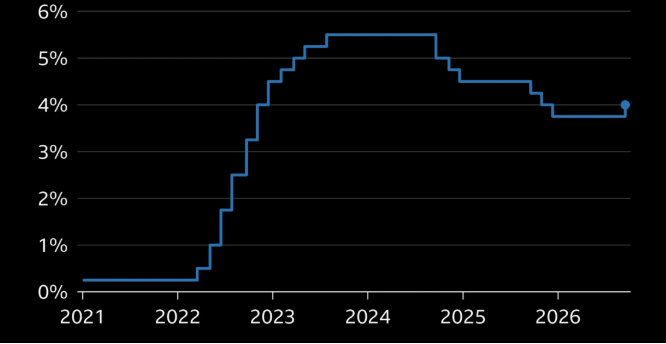
US interest rates have been raised for the first time in more than three years and could be increased further in a bid to slow rising prices.
Rates were hiked to 3.75%-4% from 3.5%-3.75% by the Federal Reserve in a unanimous decision on Wednesday despite fierce opposition from President Donald Trump, who had called for rates to be cut.
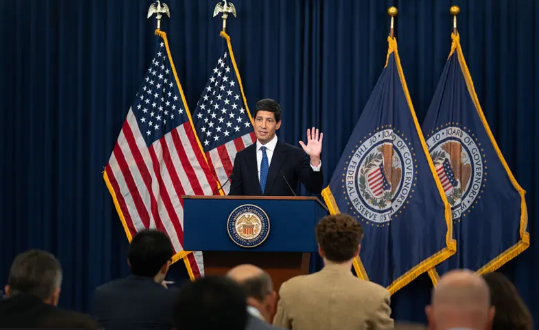
Fed Chair Kevin Warsh said the move was because “inflation is too high and has been for too long”, adding that it was a “sober” and “responsible decision”.
However, Trump said rates “should be 1%, or less, because we are the Best Credit in the World – BY FAR”.
Higher interest rates make borrowing more expensive for people wanting to secure loans, mortgages and credit cards, but can lead to better returns on savings.
Central banks tend to increase rates when inflation is high to discourage spending and encourage saving in the hope this will reduce the pace of price rises.
But it’s a balancing act, as higher rates can also encourage businesses to hold off on investing and hurt economic growth.
Global oil prices have surged since the start of the US-Israel war with Iran, driving up the price of car fuel as well as the cost of goods and services generally.
Yet, despite this, Warsh said the US economy was in a strong position and this was one of the things which encouraged the Fed to cut rates.
We are ending our live coverage of the interest rate decision, but you can continue to read about the increase, the political reaction and where the US economy may be headed here.
Today’s decision raises questions about Warsh being Trump’s ‘sock puppet’
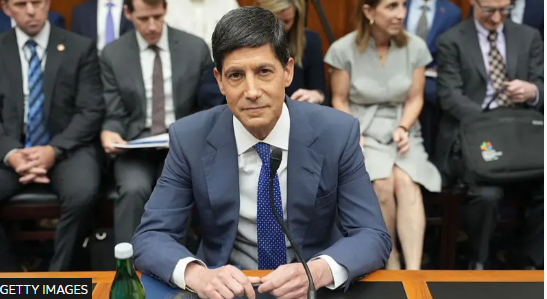
Some Fed watchers are suggesting Chairman Kevin Warsh today demonstrated that he is acting independently of the man who nominated him for the post, President Donald Trump.
The unanimous decision means Warsh voted to raise rates, going against Trump’s very public calls for them to be cut. During the press conference following the announcement, he wouldn’t answer questions about Trump’s possible reaction and said independence is a “two-way street” where he would not comment on the president’s actions.
During Warsh’s confirmation hearing, Democrats had said he would be little more than Trump’s “sock puppet” if he became the Fed chair.
Trump had suggested that, were he to be confirmed, Warsh would conform to his agenda and lower rates, which the president has consistently argued is necessary to boost the US economy.
Trump repeatedly and angrily criticised the previous Fed boss, Jerome Powell, over interest rates, both in his first term and since returning to the White House.
In Warsh’s confirmation hearing, Senator Elizabeth Warren, from Democrats’ liberal wing, said that “having a sock puppet in charge of the Fed would give the president access to the Fed’s powerful authorities to enrich himself, his family and his Wall Street buddies”.
Warsh told the hearing he “absolutely” would not be a puppet, adding that the independence of America’s central bank “is essential” and vowing to preserve its self-governance.
“The president never once asked me to commit to any particular interest rate decision, period, and nor would I ever agree to do so if he had,” he said. “But he never did.”
Trump reacts by demanding Fed lower rates and says US is ‘booming’published at 05:49
In his first public comments since the Fed raised interest rates, US President Donald Trump has once again demanded the central bank lower rates.
“Interest Rates in the United States should be 1%, or less, because we are the Best Credit in the World — BY FAR,” he says in an online statement.
“Our Country is BOOMING with new Investment! If we stopped Trading with every country that we have a Deficit with, which is most of them, we would make, at least, 1.5 Trillion Dollars a year… LOWER THE INTEREST RATES FOR THE UNITED STATES OF AMERICA, AND FAST!”
How today’s rate hike could affect upcoming congressional electionspublished at 05:31
The midterm elections that could change the balance of power in Congress are now less than 50 days away. House and Senate candidates may be the ones with names on the ballot, but Trump and the economy are also present and could influence which party prevails in the election.
Last week, Trump, who made the economy and affordability a key part of his 2024 reelection message, told voters: “Pretend, please, that I’m on the ballot.”
Today’s rate hike is “terrible news” but Angie Wong, Miami Republican Committeewoman, says it is unlikely to move the needle before most voters head to the polls.
“Even with the [rate] hike of 25 base points, you are not going to see all that much difference over the next five to six weeks left of the election campaigning season,” Wong tells the BBC. “I don’t know if this is really going to make or break the election.”
But Johanna Maska, former aide to President Barack Obama, says voters are already paying attention to the economic health of the country under Trump.
“It was going to be an issue no matter what the Fed did today,” she says. “But moving forward, the Democrats need to have an answer to what we are going to do.”
US dollar rises after rate hikepublished at 05:23
The US dollar is currently strengthening against major currencies, including the pound and euro.
The pound was down 0.67% at $1.34. The euro weakened 0.61% against the US dollar to $1.147.
The dollar index, which measures the greenback against a basket of currencies including the pound and euro, rose 0.66% to 100.27 – its highest level since the beginning of August.
Markets held steady at first, but stocks are now fallingpublished at 05:02
Francisco Velasquez
Business reporter
The US central bank raised interest rates today to fight inflation, which is viewed as a huge risk in the US economy, but stock markets dropped anyway. When the decision was first announced, share prices largely held steady, but then they began falling as Wall Street digested the news.
Why the sour mood? Investors worry the Fed is moving too slowly, pushing borrowing costs to 17-year highs.
What does it mean for you?
- Pensions and savings: When markets dip, your long-term savings take a hit.
- Loans and mortgages: US trends trickle everywhere, keeping borrowing pricey.
The big picture? Expect higher borrowing costs to stick around a bit longer.
First reaction to rate increase from White House: ‘Unfortunate’published at 04:51
We just heard from the White House’s Senior Deputy Press Secretary Kush Desai, who spoke on Fox News about the Federal Reserve’s interest rate increase.
The Fed’s decision was “unfortunate”, Desai said, and it was “not, from the administration’s point of view, backed by a compelling economic case”.
“All higher interest rates will do now is stymie the economic progress that the United States has made under this president and administration,” he said. “It will raise mortgage rates for every American and punish businesses trying to expand and grow and again.”
“None of that gets the core of the issue here, which are energy prices,” he added.
But when asked if President Donald Trump still believed in the traditional independence of the Federal Reserve from the White House, Desai said “absolutely”.
He added that Trump “has a First Amendment right as an American citizen and as a duty as our commander in chief to voice his opinions when things go awry,” he said.
We are still waiting to hear from Trump himself.
Democrats: The interest rate hike will make life harder and Trump is to blame
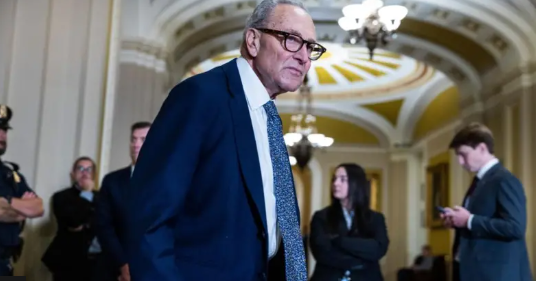
Chuck Schumer says Americans are paying more because of Trump’s “incompetence”
After the Fed announces its first rate hike in three years, we are seeing reactions from Democratic lawmakers.
One of the top Democrats in Congress, Chuck Schumer, says while speaking on Capitol Hill: “Make no mistake about it. This is going to make everything become more expensive.”
“This is because Donald Trump does not know how to manage the economy,” the Senate minority leader goes on. “Americans pay more for Trump’s incompetence.”
Brendan Boyle, the most powerful Democrat on the House Budget Committee, says in a statement: “Donald Trump will undoubtedly try to blame anyone but himself for this rate hike.
“But if he wants to know who caused it, he should look in the mirror.”
Meanwhile, House Democrats have published a post on social media: “Because of Trump’s war with Iran and sky-high inflation, interest rates are going to be even HIGHER.
“That means loans for cars, homes and credit cards will be even more expensive and more Americans will go into debt.”
The Federal Reserve isn’t the only central bank grappling to control rising prices – the oil price shock is being felt across the world.
The US central bank also isn’t the first to raise rates. Last week, the European Central Bank hiked its main interest rate to 2.5%.
All eyes now turn to the Bank of England, which will decide dates tomorrow – though a hold in the UK is widely anticipated.
Central banks are always weighing up the impact of increasing, holding or lowering interest rates – it’s a balancing act, as I noted earlier.
While higher rates can ease inflation, they can also discourage businesses from investing, hiring people or creating jobs – all this can have an impact on economic growth. Not wanting to cut off any growth shoots in the UK might be behind the expectations the Bank of England will hold rates tomorrow.
The BBC took a longer look at what the Fed and Bank of England are up against here.
How does the Fed’s statement differ from last time?published at 04:16
Each time the Fed announces an interest-rate decision it puts out a brief statement on how it came that decision.
Now that the press conference is over, we’ve looked at how today’s statement differs from the one released in July.
Here are the three biggest changes we noticed.
“Geopolitical developments” vs “Middle East”
- Today: While uncertainty remains elevated owing, in part, to geopolitical developments, domestic spending has been resilient…
- July: Economic activity is expanding at a solid pace despite elevated uncertainty that owes, in part, to the conflict in the Middle East…
Capital investment is “robust” vs “strong”
- Today: Productivity growth is strong, and capital investment is robust
- July: Productivity growth and capital investment are strong…
“Timelier return to 2 percent goal” vs “supply shocks”
- Today: Inflation remains elevated. Today’s policy action will support a timelier return to the Committee’s 2 percent goal…
- July: Inflation remains elevated relative to the Committee’s 2 percent goal, in part reflecting supply shocks that have driven price increases in certain sectors, including energy…
Press conference ends with Warsh saying Fed can ease inflation without harming labour marketpublished at 04:10
 Image source,Reuters
The last question to Warsh was about labour markets – particularly how higher rates might harm them.
“I don’t believe we need to do harm to the labour market to achieve our objectives,” he says, adding that the Fed’s two mandates (price stability and full employment) can work alongside each other.
Ensuring price stability will help economic growth and help those who are the least well off, he says.
With that, the press conference ends.
Fed is looking closely at how AI could affect US economypublished at 04:05
 Image source,Getty Images
A CNN journalist asks Warsh about AI and whether it could cause damage that affects the economy.
Warsh says he has spent a lot of time thinking about this.
The Fed cares about AI and its implications for demand and supply in the job market and the whole economy, he says.
The chairman says the institution has established a task force that should report by the end of the year, to help it consider AI’s implications for future policy.
But policy decisions, he adds, are made by other parts of the government.
“I’m going to leave it to them to make those political decisions,” Warsh says, while the Fed focuses on the implications of those decisions that affect its work.
Europe’s central bank raised its rate – here’s what Warsh says about itpublished at 04:03
 Image source,EPA
Asked about rate hikes by the European Central Bank, the Fed chairman says he won’t prejudge the decisions of the Frankfurt-based bank.
He says in meetings with central bank leaders around the world, he has heard they are dealing with price pressures as well and those decisions affect the US, albeit to a lesser extent.
“When foreign central banks make decisions… they are helping to squash inflation in their countries and there is spill over and spill backs in both directions,” he notes.
This was a pretty straight-forward decision in Warsh’s eyespublished at 04:01
 Image source,Reuters
“The plain fact is inflation is too high and has been for too long,” Warsh told the press conference.
That sentence neatly summarised the rationale behind the Federal Reserve’s decision to raise interest rates.
It’s clear that Warsh sees easing price rises – restoring what he calls “price stability” for Americans – as his priority. He’s happy with how the jobs market is looking and how the wider economy is holding up, despite the US-Iran war pushing up prices.
Notably, Warsh chuckled in response to questions regarding what message this sent to President Trump, who called for rates to be cut.
“I have got nothing for you on a discussion with the president,” he said, and went on bat away similar questions.
When it came to future rate decisions, Warsh revealed he had declined to offer his own projection.
“I’m not in the forward guidance business,” he said.
There was a sober tone to his answers during this press conference. He has been clear that tackling inflation is the top priority of the Fed, and Trump, despite his objections, won’t get in the way of that.
Warsh asked how interest rate decision will affect lower-income Americanspublished at 03:58
A reporter asks how the least well-off Americans will be affected by a higher interest rate.
The least well-off are those who don’t own financial assets, he says, describing them as less than 50% of the country and living off their paychecks. Rising interest rates could potentially squeeze business owners, home buyers and bond holders.
The Fed’s job is to “ask ourselves if the country is running more or less at full employment”, which he says they have done, and keeping prices stable so people can have real take-home pay.
Will there be a post-decision meeting with the president?published at 03:56
 Image source,Reuters
Warsh, pictured here in May 2026 alongside Donald Trump, at his swearing in ceremony
Warsh is asked again about Trump.
“When was the last time you spoke with the president? Do you anticipate a post-decision meeting?” a journalist asks.
Warsh laughs.
“I don’t have anything for you on discussions with the president, and I’m not a Wall Street newsletter,” he says.
“Part of the independence of the Federal Reserve is we stay in our lane. Independence is a two-way street. We’ll let people that do trade policy and fiscal policy stay in their lane too.
“That’s how we can stand up here and call them the way we see them,” he says.
‘Trends matter, data points are noisy’ – Fed chairpublished at 03:55

A retail sales report showed US shoppers are spending more
Warsh says he “wasn’t waiting breathlessly” on any data to make his decision referring to regularly scheduled government reports on the US economy, including one on retail sales posted this morning and the much-watched CPI report.
“Trends matter, data points are noisy,” he says. “Data point dependence is a dangerous preoccupation.”
This morning’s report showed US shoppers are spending more, with retail sales rising 1.2% in August.
Three main factors drove today’s decisionpublished at 03:53
Warsh is asked what has changed since the last rate decision in July – when the committee chose to hold the interest rate.
He lays out three points that informed the decision this time:
- A stronger economy: Data and labour markets show that the economy has strengthened, Warsh says
- Inflation trends: Summer inflation trends were “not passing the test”, he notes
- And geopolitics: “There’s no hiding from hotspots around the world,” he says
Warsh asked about Trump’s possible reactionpublished at 03:52
Warsh was asked what his message was to Donald Trump, who has repeatedly called for interest rates to be cut, not raised.
“I’ve got nothing for you on a discussion with the president,” he replies.
He reiterates that the least well-off have the most to gain from stable prices, and that today’s rate rise will “ensure stable prices”.
As a reminder: Trump has pushed for lower interest rates since beginning his second term, which led to a major, public dispute with Warsh’s predecessor.
Did the markets influence the Fed to raise rates?published at 03:50
Warsh says the rate hike today was based on the Fed’s assessment of the strength of the economy and was not led to it based on the market forces.
Most of those in financial markets had treated an increase as a nailed-on certainty, which was reflected in stock prices and bond yields this week.
Rate increase was a ‘sober’ and ‘serious’ decisionpublished at 03:48

The decision to raise interest rates has been a possibility for months, since the beginning of his term, Warsh says.
“The decision we made today was a sober decision, serious decision, responsible decision, one that we have been preparing for and thinking about in my 120 days here,” he says.
He adds that he’s not going to prejudge decisions about future rate hikes.
First question to Warsh focuses on conflict in Middle Eastpublished at 03:46
After his statement, Warsh begins taking questions from the media.
He’s first asked if he thinks rate rises can address the supply-side of inflationary pressures, namely the rising price of oil due to disruption in the Strait of Hormuz.
Warsh says: “We cannot affect any individual price, whether it be oil prices, whether it be foodstuffs at the grocery store.”
“But what we can do and will do is ensure that any change in relative prices don’t broaden out,” he adds.
Fed has a mandate to help stabilise prices – Warshpublished at 03:44
 Image source,Reuters
The Fed has role in stabilising prices, Warsh says referring to one of the central bank’s dual mandates.
“Those who are least well off have the most to gain from a durable expansion, a solid labour market, and stable prices,” he adds.
And with that he opens the floor for questions.
How does the Fed’s decision compare to other countries?published at 03:43
Warsh now turns his attention to other advanced economies, saying most are also facing pressures.
“Our decision reflects our best judgement,” he says.
Last week, the European Central Bank raised its main interest to 2.5%.
Fed must be confident inflation is easing, Warsh sayspublished at 03:42
Warsh says “we must be confident that underlying inflation is moving to our objective, clearly and at sufficient speed”.
Today, he adds, the FOMC decided that “this standard has not been satisfied”.
- What is inflation again? It’s the increase in the price of something over time. For example, if a bottle of milk costs $1 but is $1.05 a year later, then annual milk inflation is 5%
‘Plain fact is inflation is too high, for too long’published at 03:41
Warsh says there is “an attitude of optimism” within the Federal Reserve leadership however there inflation remains a persistent issue.
“For more than five years, inflation has been running above target,” he says. “The plain fact is that inflation is too high and has been for too long. This summer’s inflation readings do not tell me that underlying trends have improved.”
Fed says rise should bring ‘timelier return’ to 2% inflation goalpublished at 03:40
After announcing the news we saw a few minutes ago – that the federal interest rate has been raised – Warsh then reads the statement the Fed released.
As a reminder, that statement said:
- Economic activity is expanding at a solid pace
- Uncertainty remains elevated, owing in part to geopolitical developments
- Domestic spending has been resilient
- Job gains have kept pace with the workforce
- Inflation is still elevated, and the Fed hopes today’s action should support a “timelier return” to its 2% inflation goal
Fed chair Warsh is speaking now – watch live abovepublished at 03:32
 Image source,Reuters
Fed Chairman Kevin Warsh is speaking now – he’ll be taking questions too.
We’ll bring you the latest here, but you can also follow along by pressing watch live above.
Fed chairman to take questions shortlypublished at 03:25
For the first time in three years, the US federal interest rate has risen.
In just a few minutes, Federal Reserve Chairman Kevin Warsh will speak to the press about the decision, which was unanimous among the Fed’s Open Market Committee (FOMC).
Reporters will undoubtedly have a lot of questions for Warsh, especially considering repeated pushes by President Trump to keep the rate down.
We will bring you the key lines here, and you can also watch live by clicking the play button above.

Fed forecasts inflation to ease in coming yearspublished at 03:24
Price rises are set to ease in the coming years, according to projections from the US central bank.
Inflation, which is a measure used to assess the cost of living, will likely be 3.7% for 2026, meaning prices were 3.7% higher on average, than the year before.
The rate is expected to fall to 2.3% next year, and 2.1 in 2028, before hitting the Fed’s 2% target in 2029, the projections show.
The main driver of inflation in the US has been energy – with gas and diesel prices pushed higher as a result of oil prices rising around the world due to the US-Iran war.
Further rate rises expected before the end of yearpublished at 03:16
As well as announcing the latest interest rates decision, the Federal Reserve has released its latest economic projections showing where board members see rates going from here.
Most policymakers think that rates will be hiked again before the end of this year to between 4-4.25%, and a small majority believe they could rise to the 4.25-4.5% next year.
The projections suggest rates could be lowered later, as we move into 2028 and 2029.
But remember: It’s important to note that these are just predictions based on how the future might look – as we have seen through previous economic shocks caused by Covid and wars, things can change quickly.
Fed raises interest rates – five things you need to knowpublished at 03:13
- The Fed has announced that rates are rising – the first increase in three years
- It raised rates from 3.5-3.75% to 3.75-4%
- The board voted unanimously, 12-0
- However, this was expected, our business reporter writes
- The Fed’s forecasts also suggest another increase could happen before the end of the year
Economic activity expanding at ‘solid pace’ despite geopolitical uncertainty – Fedpublished at 03:08
 Image source,Getty Images
In announcing the hike, the Fed also highlights bright spots and says economic activity is expanding “at a solid pace”.
“While uncertainty remains elevated owing, in part, to geopolitical developments, domestic spending has been resilient,” it also says in its statement.
“Productivity growth is strong, and capital investment is robust. Job gains have kept pace with the workforce, and the unemployment rate has changed little,” its statement says.
The main concern – and the one leading to the first rise in three years – is that “inflation remains elevated” (our business reporter explained why that is earlier).
How will Trump react?published at 03:04
 Image source,Reuters
The Fed has announced, as expected, that the Fed is raising interest rates. Now comes the less certain part: How will Donald Trump react?
In the past, the president has been sharply critical of the Fed’s interest rate moves, claiming former Chair Jerome Powell was too slow in lowering rates when it appeared inflation was under control.
His words were less sharp about the prospect of a hike now that Warsh has been in the post. But with a higher rate now a reality, will the mercurial president change his attitude?
Trump – and his Republican allies – had been hoping good economic news would improve their prospects in November’s midterm congressional elections. A rate hike, however, is the latest sign that prospects of such a positive turn are rapidly dimming.
That won’t sit well with the president, whether he acknowledges it or not.
An expected move, which the Fed hopes will ease affordability in the long termpublished at 03:01
Rates being increased was almost a nailed-on certainty by financial traders, so the decision will not come as a surprise to banks and other money lenders.
They may have already factored in higher rates to their own lending and savings products.
It’s clear the Fed deems prices are rising too fast and interest rates need to go up to limit inflation.
However, with Donald Trump calling for rates to be cut, all eyes will turn to see how the president reacts.
This decision won’t be welcomed by people looking to borrow cash, but the central bank will hope the move will – over time – ease the cost of living for Americans.
-
US central bank raises interest ratespublished at 03:00
BreakingThe US Federal Reserve has raised interest rates for the first time in three years.
The Fed has increased its rate from 3.5%-3.75% to 3.75%-4%.

-
Will interest rates rise? We’re about to find outpublished at 02:55
In the next few moments, we’ll hear whether the US Federal Reserve has decided to raise interest rates.
They’re currently set at 3.5%-3.75%, and haven’t been hiked in three years.
We’ll bring you their decision right here and explain what it means for your money.
We’re then expecting to hear from the chair of the Federal Reserve, Kevin Warsh, who will explain more about the central bank’s decision and likely give his assessment of the health of the US economy.
You’ll be able to watch that live at the top of this page.
-
Fed chair wants ‘no politics’ in decision – but Trump could make that trickypublished at 02:51
Fed Chairman Kevin Warsh has said his goal is “for there to be no politics” in the central bank’s decision making.
He’s stressed the importance of the Fed’s independence, but keeping the politics out of interest rate decisions will be tricky when President Donald Trump disagrees with the strategy and the midterm elections are looming.
 Image source,Getty Images
-
It’s been over three years since the Fed raised interest ratespublished at 02:44
The last time the Federal Reserve decided to raise interest rates was more than three years ago, in July 2023, when it hiked its policy rate to between 5.25% and 5.5%.
Inflation (a reminder here of what that is) back then was actually lower than it is now – 3.2% vs 3.4%.
Since the summer of 2023, there rates have been lowered, to the current range of 3.5% to 3.75%, but they have been held at the same level fives times since the decision to cut was made back in December 2025.

-
Up, down, hold – How the Fed’s rate decision will hit your pocketpublished at 02:35
Francisco Velasquez
Business reporter Image source,Bloomberg via Getty
We’re less than half an hour away from the Fed’s announcement, but whether the bank decides to move interest rates or stay put – your wallet could feel the ripple effects.
Here’s a look at how you’d feel it most immediately:
- If rates go up… Borrowing gets pricier. New mortgage rates, credit card APRs, and personal loans jump. At the same time, your savings account earns more money
- And if rates are cut… It becomes cheaper to take out a new loan or buy a home, but you earn less interest on savings
- But if they hold… It stays expensive to borrow, but your savings yields stay high
Beyond your personal finances, holding rates steady carries broader risks for the economy. Brent Wilsey, chief investment officer at Wilsey Asset Management, warns that approach “could surprise stocks”.
It could also “damage the Fed’s credibility” and look like the bank is simply “caving to political pressure,” he adds.
-
US prices remain high as fuel costs squeeze household budgetspublished at 02:23
 Image source,Getty Images
The rising cost of living for US households has been driven largely by the cost of oil increasing worldwide, due to the US-Iran war causing supply and trade disruptions.
The price for a barrel of Brent crude, the global benchmark for oil prices, is around $108 following recent escalations in the conflict – this directly increases gasoline and diesel prices due to it being the key ingredient of motor fuel.
As prices at the pumps push up costs for drivers, they also add costs to haulage and delivery companies which transport goods.
Such costs can be passed down to consumers through steeper prices for food and other staples, pushing up the overall cost of living.
- A reminder: the cost of living in the US is measured by inflation, which looks at how the prices of goods and services are rising
-
Remind me, what is inflation?published at 02:18
 Image source,Getty Images
Image caption,
US household budgets have come under mounting pressure, especially at the fuel pumps, with a gallon of diesel hitting a new all-time high of more than $6 on average last Friday
As we’ve been reporting, the US central bank can raise interest rates as a tool to tame inflation. But what does that actually mean?
Inflation is the word used to describe price rises over time.
The figure is generally measured on an annual basis, comparing prices now with what they were last year.
Latest figures show inflation in the year to August was 3.4%, meaning prices on average are now 3.4% more expensive than they were the year before.
Prices usually always rise, but most central banks like to keep it at a controlled rate of 2% each year.
This prevents what is known as deflation, which is when prices keep going down.
While cheaper prices might sound like a good thing at first, it can have a detrimental effect on jobs and wages.
-
-
Here’s why central banks raise interest ratespublished at 02:11
 Image source,Getty Images
Image caption, The higher rate range set by the Fed in recent years has meant people are paying more to borrow money for things like mortgages
Interest rates are the Federal Reserve’s main tool in trying to maintain the annual rate of inflation at – or close to – its target of 2%.
Inflation in US has been running above that level for some time and latest figures show consumer prices rose 3.4% from August 2025, to this year.
Fed chair Kevin Warsh has said “the Fed’s predominant focus right now should be on prices” – fuelling expectations of a rate hike.
The theory behind increasing interest rates to tackle inflation is that by making borrowing more expensive, more people will cut back on spending and that leads to demand for goods falling and price rises easing.
The rate range set by the Fed heavily influences the borrowing rates set by banks and other lenders.
The higher level in recent years has meant people are paying more to borrow money for things like mortgages and credit cards, but savers have also received better returns.
There’s always a balance between raising rates to tackle inflation. High rates can lead to lower inflation, but there’s a risk it can lead to businesses holding off of investing and creating jobs, and stunt economic growth.