
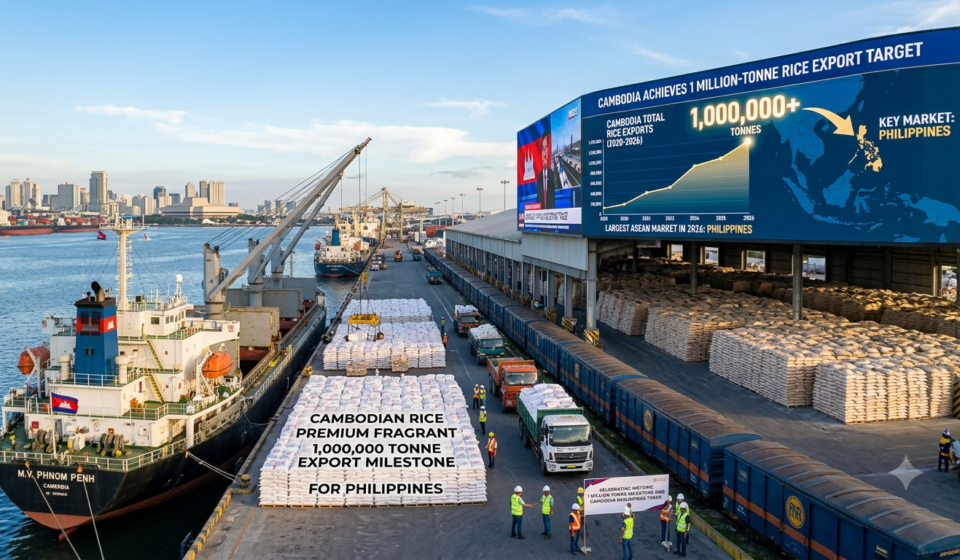

The quality, taste and reputation of Cambodian rice is gaining increasing recognition in international markets, with the Philippines emerging as one of Cambodia’s key export destinations. The Philippines imported 219,881 tonnes of Cambodian rice during the first 10 months of 2026, accounting for 20.45 per cent of Cambodia’s total rice exports.
Export growth is seen as a positive sign for Cambodia’s rice sector, particularly in expanding overseas markets and helping the Kingdom achieve its ambition of exporting 1 million tonnes of rice annually, a target set more than a decade ago.

Cambodia, Philippines pledge expanded agricultural cooperation
Following a meeting between Minister of Agriculture, Forestry and Fisheries Dith Tina and Philippines ambassador to Cambodia Senen T. Mangalile on November 12, both sides expressed satisfaction with the growing cooperation between the two countries in agriculture, trade and food security.
During the meeting, the two sides highlighted the significant increase in Cambodian rice exports.
They expressed their readiness to expand cooperation in the agri-food sector to generate mutual benefits for farmers and consumers in both countries.
According to the agriculture ministry, Cambodia exported 1,014,442 tonnes of rice between January 1 and October 19, 2026, setting a new historical record and achieving its annual rice export target of 1 million tonnes.
Cambodian rice poised to gain a larger share of the Philippine market
Lay Chhun Hour, president of the Cambodia Rice Federation (CRF), told The Post on November 13 that the Philippines is one of the world’s major rice-importing countries, importing approximately 5 million to 6 million tonnes annually to meet domestic demand.
He said the Philippines’ major rice suppliers have traditionally included Vietnam, Thailand, Pakistan and India. However, Cambodian rice is also gaining opportunities to expand its presence in the market as buyers increasingly recognise its quality, taste and reputation.
“The Philippines is playing an important role in helping Cambodia fulfil its ambition of exporting one million tonnes of rice annually. This market will continue to play an important role in Cambodia’s rice exports in the future,” he said.
He added that Cambodia exported more than 200,000 tonnes of rice to the Philippines since the beginning of 2026, demonstrating the market’s considerable potential.
Chhun Hour explained that most shipments consist of white rice with a soft texture, particularly the OM 5451 variety. This type has attracted considerable interest from buyers in the Philippine market because its characteristics suit local consumer preferences.
Cambodian rice good quality, faces higher prices
However, Chhun Hour noted that pricing remains a key factor affecting the competitiveness of Cambodian rice. Currently, Cambodian rice exported to the Philippines is priced approximately $30 to $80 per tonne higher than rice imported from Vietnam.
“This is a large market that offers Cambodia considerable opportunities, provided the Kingdom’s rice is not priced significantly higher than that from other nations,” he said.
According to Chhun Hour, maintaining product quality, ensuring a stable supply and setting competitive prices are essential to retaining Cambodia’s existing market share and attracting additional buyers.
The growth in rice exports to the Philippines also highlights the importance of diversifying Cambodia’s export markets to reduce reliance on a limited number of destinations and create more opportunities for domestic agricultural products.
In particular, expanding export markets could provide broader opportunities for rice millers, exporting companies and rice producers across the country.
Overall, the growing recognition of Cambodian rice in the Philippine market presents an important opportunity to strengthen the Kingdom’s export capacity.
Cambodia exported over 940,000 tonnes of rice in 2025
In 2025, Cambodia exported 940,321 tonnes of rice, generating revenue of $602.41 million. The exports were handled by 68 companies and shipped to 75 destinations worldwide.
Of the total, shipments to 28 European countries amounted to 339,417 tonnes, while exports to China and Hong Kong reached 231,125 tonnes.
Meanwhile, exports to eight ASEAN member states totalled 273,657 tonnes, while shipments to 37 other destinations across Africa, the Middle East, the United States, Canada, Australia and New Zealand amounted to 96,122 tonnes.