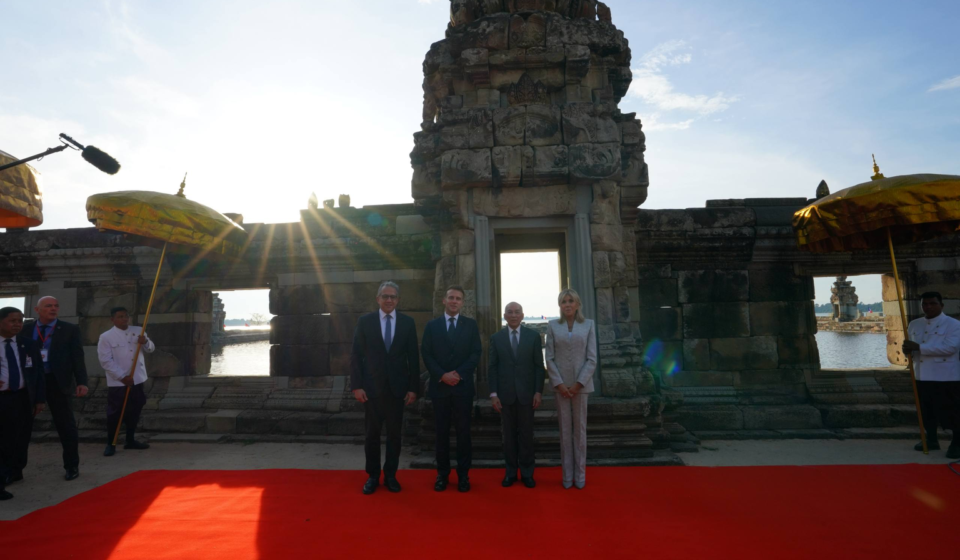

French President Emmanuel Macron praised decades of cooperation between Cambodia and France in preserving the Kingdom’s cultural heritage as he joined King Norodom Sihamoni to mark the completion of the restoration of the Western Mebon Temple in Siem Reap today, November 16.
The ceremony marked the end of a 14-year restoration project at the 11th-century temple, which stands on an island in the West Baray, an enormous ancient reservoir often described as reflecting the Khmer civilisation’s achievements in water management.
Macron said the restoration demonstrated what Cambodian and French experts could accomplish by combining their knowledge and skills, while paying tribute to the generations of Cambodian builders whose work had left a lasting mark on the country’s history.
“The Cambodian and French experts have worked together to rebuild what time, nature and human conflicts had brought down,” he noted.
Macro recalled the 1936 discovery of a monumental bronze statue of the Hindu god Vishnu among the temple’s ruins. The reclining sculpture, one of the largest known Khmer bronze works, was restored in Nantes, France, and displayed at the Guimet Museum in Paris before being presented to audiences at major museums around the world from late last year.
The French president noted that the restoration of the temple had required years of painstaking work, including controlling water levels and transporting thousands of tonnes of sand, laterite and sandstone to the site.
He said several hundred people, including stonemasons, artisans, sculptors, restorers, archaeologists, architects and hydraulic engineers, had contributed to the project.
He also recognised the role of the École française d’Extrême-Orient (EFEO), which has supported archaeological research and conservation in Cambodia for more than a century, as well as UNESCO and the International Alliance for the Protection of Heritage (ALIPH).
France and Japan have co-chaired the International Coordinating Committee for Angkor since the archaeological site was inscribed on the UNESCO World Heritage List in 1992.
He explained that France wanted to continue its cooperation with Cambodia on equal terms, stressing that Cambodian institutions now had the capacity to lead future restoration projects themselves.
“This will be a renewed cooperation between equals, and France is not coming here to do the work in your place, because your institutions, like the teams of the APSARA National Authority, now have all the capacity and determination to continue the reconstruction work themselves,” he said.
He added that France would continue providing support where requested, including through technical training, digital preservation and immersive technologies. The Guimet Museum had also offered to share its expertise with the National Museum of Cambodia as part of ongoing discussions on modernization, according to Macron.
King Norodom Sihamoni, in his address, expressed gratitude to France and each of the institutions involved, describing the restored temple as an important achievement in the longstanding friendship between the two countries.
The King said the restoration, launched in 2012 with support from the French Ministry for Europe and Foreign Affairs, had been carried out through close cooperation between the APSARA National Authority and the French embassy in Phnom Penh, with contributions from domestic and international experts.
“Over 14 years of work, research and patience, this Franco-Cambodian team has brought this majestic monument back to life, stone by stone, and restored it to its place at the heart of the waters of the Western Baray,” he said.
The king said the project had also helped pass traditional skills to a new generation of Cambodian workers, with local stonemasons rediscovering techniques used by their ancestors.
“This is the essence of genuine cooperation: Working together so that each side can eventually carry out the work independently,” he said.
The monarch also recalled previous visits to Cambodia by French presidents; Charles de Gaulle in 1966 and François Mitterrand in 1993. He said Macron’s visit in 2026, during the 20th Francophonie Summit, further strengthened a friendship shaped by history and sustained through cultural and heritage cooperation.
He thanked the Royal Government, the Ministry of Culture and Fine Arts, APSARA and all those who had worked on the restoration, saying the monument should serve as a reminder that great achievements require knowledge, hard work and lasting peace.
“May this Western Mebon, a privileged witness to the creative genius of humanity, forever remind us that great works of humanity are born from the combination of knowledge and labour, require an atmosphere of lasting peace, and aspire to serve the common good,” the king said.