
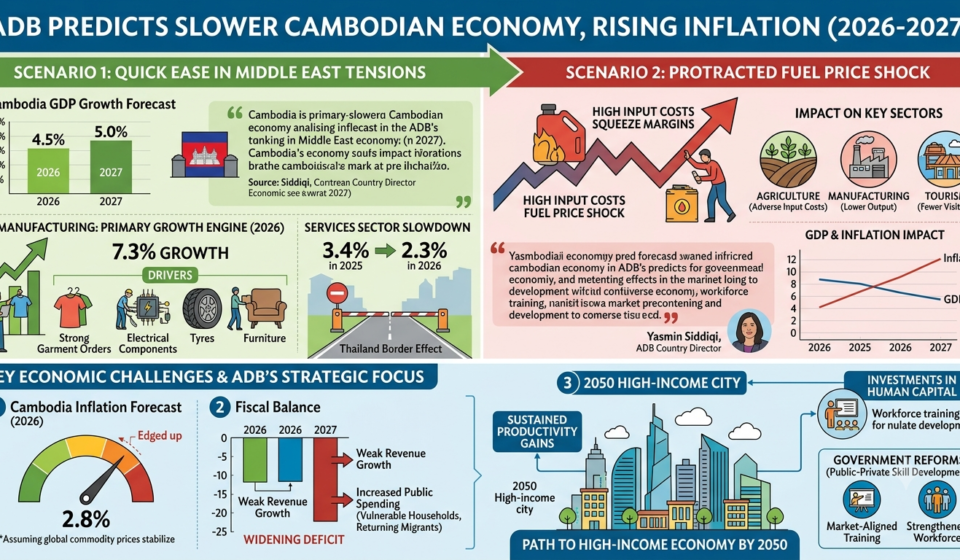

The Asian Development Bank (ADB) has predicted a slowdown in the growth of Cambodia’s economy. It estimated that it will grow at around 4.5% in 2026, if global commodity market disruptions are not prolonged by the conflict in the Middle East.
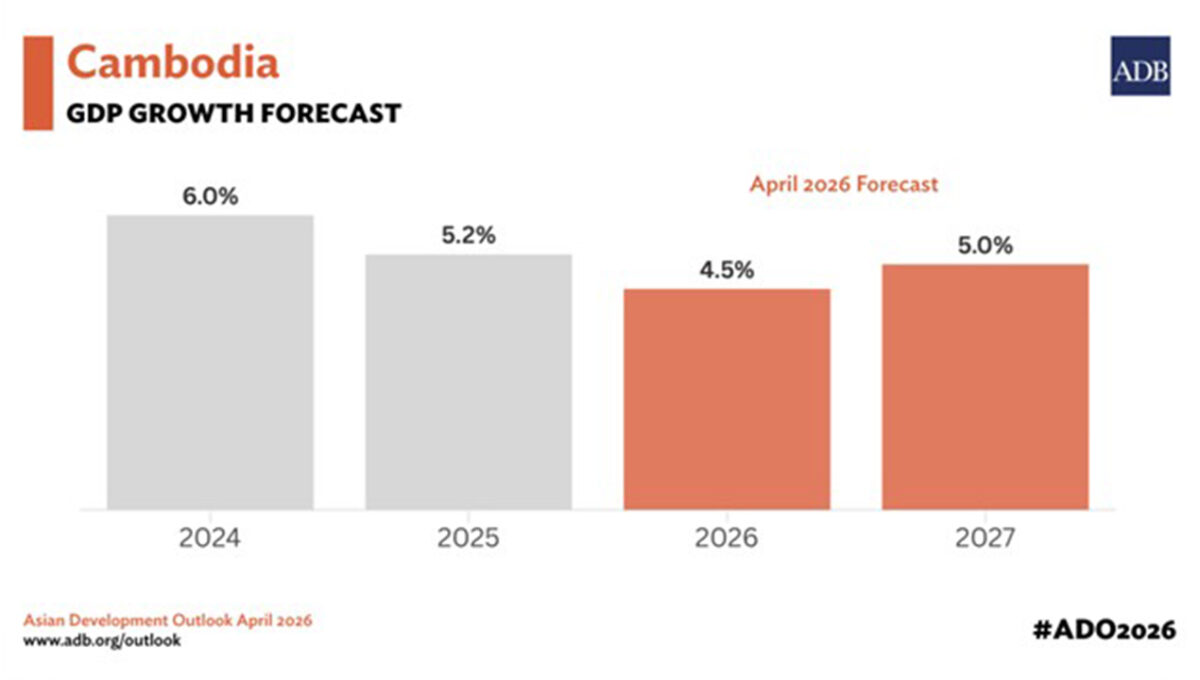
In an April 10 report, the ADB stated that under a scenario where tensions in the Middle East ease quickly, growth will be supported by the resilience of the manufacturing sector. In this case, Cambodia’s economic growth is expected to reach 4.5% in 2026 and rise to 5.0% in 2027.
“Cambodia continues to show resilience in the face of external pressures,” said ADB country director for Cambodia Yasmin Siddiqi.
“Manufacturing remains solid, and ongoing government efforts to bolster the tourism sector will help maintain economic momentum despite global challenges. Developing a productive workforce is essential for attracting diversified, high-quality investment, while public–private collaboration in skills development is crucial to achieving Cambodia’s long-term growth objectives,” she added.
The Asian Development Outlook (ADO) April 2026 report projects that manufacturing will remain the economy’s primary growth engine in 2026, with industrial output expected to grow by 7.3%.
This is driven by strong garment orders and expanding contributions from non-garment manufacturing — including electrical components, tyres and furniture. Modest growth in the agriculture sector is expected to continue at 0.9%, supported by export demand for rice and cashew nuts. Government initiatives that promote sustainable production and reintegrate returning migrant workers into the sector will help reinforce these gains.
Services sector growth is projected to slow from 3.4% in 2025 to 2.3% in 2026 as the economy adjusts to the effects of the Thailand border closure. Foreign direct investment remained strong in 2025, with approved fixed asset investment rising by 45%, reflecting investor confidence and continued diversification into higher value production.
Inflation is forecast to edge up to 2.8% in 2026, assuming global commodity price increases due to the Middle East conflict are not sustained. A protracted fuel price shock could raise imported input costs and adversely affect agriculture, manufacturing and tourism, however.
The fiscal deficit is projected to widen further in 2026 as spending rises — including support for vulnerable households — while revenue growth weakens in line with economic growth.
Achieving Cambodia’s goal of becoming a high-income economy by 2050 will require sustained productivity gains, supported by investments in human capital. Skills gaps remain a critical constraint, with employers consistently reporting challenges in finding qualified workers.
Government reforms — such as enabling private-sector participation in public training institutions — are expected to help align training with market needs and strengthen the workforce, noted the report.